
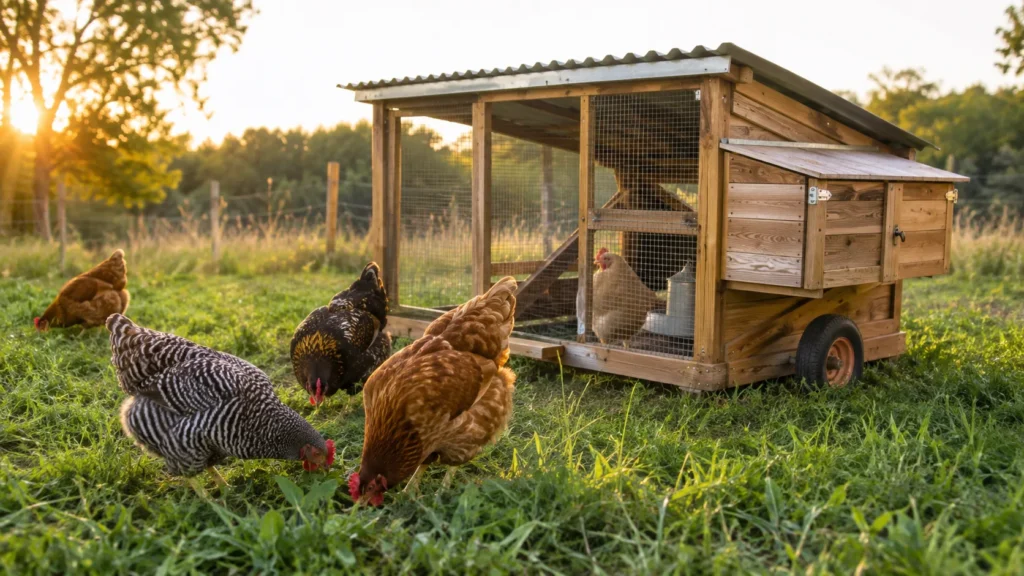
Moveable chicken coops are lightweight or wheeled coops that you can relocate to fresh ground, giving hens new forage while reducing manure buildup, mud, and wear on one patch of yard. They work best when the coop is stable, predator-resistant, easy to move, and sized for the flock you actually keep.
This guide explains how moveable chicken coops work, what features matter most, and how to use one without creating health or safety problems. It is for backyard keepers who want practical advice before buying, building, or rotating a mobile coop.
What Makes Moveable Chicken Coops Work Well?
The main value of moveable chicken coops is rotation. When chickens are not standing in the same spot every day, the ground gets a break, parasites are harder to build up, and hens have access to cleaner scratching space. A good mobile coop also gives you better control over where manure lands, which matters if you are protecting lawn, garden beds, or a small paddock.
But mobility only helps if the coop still behaves like a real coop. Birds need shade, airflow, secure nighttime confinement, dry bedding, and enough room to roost without crowding. If a mobile setup is too small or too flimsy, you trade one problem for another.
The best designs balance easy movement with enough weight, structure, and locking hardware to stay safe in wind and from predators. That is why many keepers prefer a coop on wheels or skids rather than a tiny, ultralight box that looks convenient but wears out quickly.
Expert tip: plan the coop around the hardest day of the year, not the easiest one. If you can move it alone when the ground is wet and the flock is fully grown, the design is probably practical.
Moveable Chicken Coops Setup Checklist
If you want a mobile coop that actually saves work, start with the essentials below. The goal is a setup that can be moved regularly without stressing birds or damaging the frame.
| Feature | Recommended spec | Why it matters |
|---|---|---|
| Frame strength | Rigid wood or metal frame with reinforced corners | Prevents twisting when you move the coop and keeps doors, latches, and nesting boxes aligned. |
| Mobility | Wheels, skids, or handles sized for your terrain | Makes relocation realistic instead of something you avoid because it is too heavy. |
| Floor space | Enough room for your flock plus a little margin | Overcrowding causes stress, feather damage, and poor egg laying. |
| Ventilation | High vents with predator-proof openings | Reduces moisture buildup and helps keep ammonia from accumulating. |
| Predator protection | Secure latches, strong wire, and no gaps at ground level | Mobile coops often sit in exposed locations, which makes locking points critical. |
| Roost and nest access | Stable roost bars and properly placed nesting boxes | Hens need comfortable nighttime perches and safe egg-laying space. |
| Weather cover | Solid roof and partial wind block | Protects birds from rain, sun, and drafts while still allowing airflow. |
Before you buy, think about how often you can move it and where it will live between rotations. If the route is uneven, narrow, or muddy, a “portable” coop can become stationary in practice. That is usually when owners stop using it the way they intended.
How Do You Use Moveable Chicken Coops Safely?
Pick the right location: Choose a dry, level area with enough sun and some shade. Avoid low spots that collect water and places where hawks have easy overhead access. If you rotate onto grass, aim for ground that can recover between moves.
Set a moving rhythm: Move the coop before the ground turns to bare dirt or manure starts to pile up under the door area. Many keepers rotate every few days to weekly, but the right interval depends on flock size, weather, and how quickly the spot gets worn. USDA APHIS’ Defend the Flock guidance is a useful reminder to keep birds away from contaminated areas and maintain clean conditions around poultry housing.
Lock it down nightly: Chickens should be secured before dark, with latches closed and any pop door fully fastened. Mobile coops are especially vulnerable if a raccoon or dog can push at a weak door edge. Check every hinge and latch after moving the coop because vibration can loosen hardware.
Manage feed and water: Keep feeders and waterers stable so they do not tip during movement. Spilled feed attracts rodents and can make the area messy fast. If your coop has limited headroom, choose containers that are easy to remove before you roll or drag the unit.
Watch the birds, not just the grass: If hens are panting, crowded, or avoiding part of the coop, the design needs adjustment. Mobile housing works best when birds can move comfortably, stay dry, and settle quickly at roost time. For broader flock-care basics, Cedar & Cluck’s guides on what to feed chickens and chicken coop ventilation are useful companions.
Protect the ground: Do not park a mobile coop in the same square of ground for too long. Even a good design can create a muddy, unhealthy patch if it never gets rotated. If the soil is already fragile, add a temporary base like boards or move onto a sturdier surface.
Inspect after every move: Check wheels, skids, wire, and fasteners each time you relocate the coop. Small failures often start as a loose screw, a sagging latch, or a cracked board. Catching those early keeps the coop usable longer.
Are moveable chicken coops better than fixed coops?
Moveable chicken coops are better than fixed coops when your priority is ground rotation, cleaner runs, and flexible placement. They are not automatically better for every flock, though, because they usually offer less interior space, less insulation, and more exposure to wind and weather.
For small backyard flocks on a lawn or pasture, they can be a smart choice. For larger flocks, harsh climates, or keepers who want a permanent setup with more interior features, a fixed coop often makes more sense.
| Option | Best for | What to expect |
|---|---|---|
| Wheeled mobile coop | Small flocks on relatively smooth ground | Easier to move, but wheels must be strong and properly maintained. |
| Skid-style coop | Rougher yards or keepers who drag rather than roll | Very sturdy, but harder to move on soft or muddy ground. |
| Lightweight tractor | Short-term grazing and daily rotation | Excellent for fresh forage, but often limited in weather protection and space. |
| Fixed coop with run | Heavier flocks and tougher climates | More stable and spacious, but requires more cleaning and ground management. |
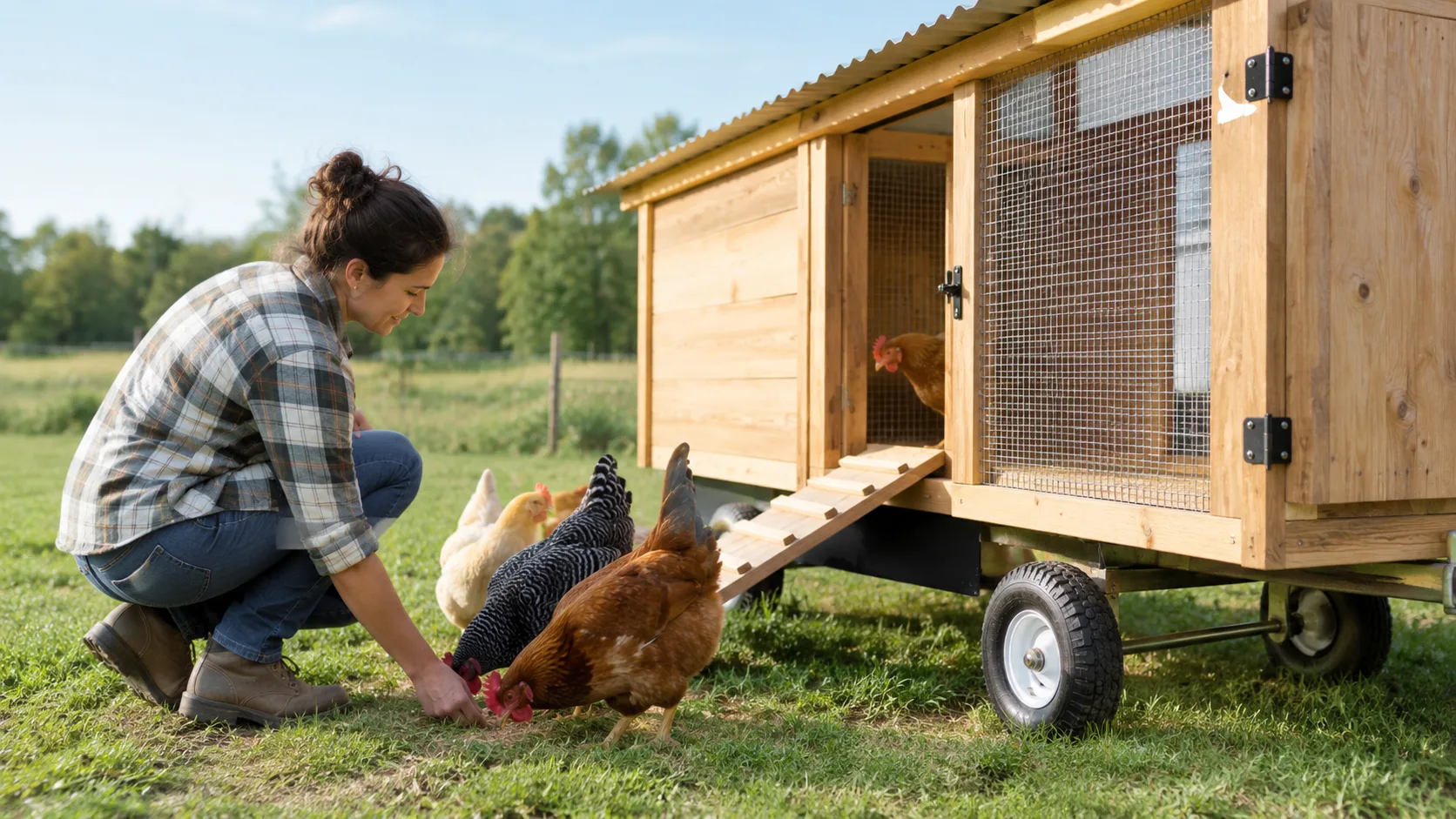
How to Adapt Moveable Chicken Coops for Your Flock
For a small beginner flock: Keep the design simple and easy to handle. A small mobile coop is usually best when you are still learning feeding, cleaning, and predator protection. If you are starting from scratch, Cedar & Cluck’s How Many Chickens Should a Beginner Start With? can help you avoid overbuilding.
For a mixed-age flock: Choose a coop with enough separation between nesting and roosting areas. Younger birds can get stressed if older hens dominate the best sleeping spots. Make sure the coop is large enough that moving it does not mean crowding birds into a tighter-than-usual space.
For wet or muddy yards: Favor wider tires, skids, or a design that can be dragged over firm paths. Put the coop on the driest ground available and move it before the area becomes saturated. If you keep moving it through mud, the coop will get heavier, dirtier, and harder to sanitize.
For hot climates: Prioritize shade and airflow over extra insulation. Mobile coops can overheat quickly if they are too enclosed or parked in full sun all day. Open vents high on the walls and use natural shade from trees or shade cloth when needed.
For backyard gardens: Use the coop as a targeted soil tool, not a free-for-all. Short rotations can help clear spent beds, but chickens will scratch, peck, and compact soil if left too long. Keep them away from tender crops unless you want the area worked over.
Companion Advice for Better Mobile Coop Results
Moveable coops work best when the rest of your setup is planned as carefully as the housing itself. If you are comparing coop sizes, start with how big a chicken coop should be so you do not sacrifice comfort for portability.
It also helps to think ahead about cleanup. A mobile coop can still get dirty fast if droppings collect under roosts or bedding stays damp, so pairing it with how to clean a chicken coop keeps the whole system easier to manage.
Common Moveable Chicken Coop Problems and How to Fix Them
| Problem | Likely cause | Easy fix |
|---|---|---|
| Coop is too hard to move | Frame is too heavy or wheels are undersized | Reduce weight, upgrade wheels, or switch to a skid-style design. |
| Birds seem stressed after rotation | Move was rough, sudden, or done at the wrong time of day | Move slowly, keep birds inside while relocating, and do it before dusk. |
| Ground turns muddy under the coop | Rotations are too slow or the area drains poorly | Move more often and avoid low-lying spots after rain. |
| Latches come loose | Vibration during movement | Use stronger hardware and inspect every lock after each move. |
| Egg production drops | Stress, heat, poor diet, or insufficient nesting comfort | Check feed, shade, nesting boxes, and daily routine. |
| Ammonia smell builds up | Too much moisture and not enough cleaning | Improve ventilation and remove wet bedding promptly. |
Most mobile-coop problems come from trying to do too much with too little structure. When in doubt, choose sturdier hardware, more ventilation, and a slightly larger footprint rather than the smallest possible build.
Keeping Moveable Chicken Coops in Good Shape
A mobile coop lasts longer when you treat it like equipment, not furniture. Check for cracked boards, bent wire, rust, and loose fasteners on a regular schedule, especially after weather changes and repeated moves. The more often you rotate, the more important those inspections become.
Penn State Extension’s poultry housing and flock-management resources are a good reminder that clean, dry housing matters just as much as convenience. If you see damp bedding, persistent odors, or droppings building up in corners, fix the source instead of just moving the coop and hoping for the best.
Store spare latches, screws, and wire on hand so small repairs happen quickly. A mobile coop that is patched promptly stays safer, quieter, and much easier to move than one that is allowed to sag for months.
Frequently Asked Questions
How often should moveable chicken coops be moved?
There is no single schedule that fits every flock. Many keepers move them every few days to weekly, depending on flock size, weather, and how fast the ground gets worn. If the area looks muddy, smells strong, or loses all cover, it is time to move.
Can moveable chicken coops stay on grass?
Yes, but not in the same spot for long. Grass offers a better surface than bare dirt, but chickens will still scratch it down quickly. Frequent rotation helps keep the grass alive and reduces mud.
Are mobile chicken coops safe from predators?
They can be, if built well. The important parts are sturdy wire, secure latches, no gaps at ground level, and closing birds up at night. A flimsy mobile coop is easier for predators to test than a solid fixed coop.
Do moveable chicken coops need nesting boxes?
Yes, if you want hens to lay comfortably and consistently. Nesting boxes should stay level, dry, and dark enough to feel secure. If the boxes bounce around while you move the coop, they may need reinforcement.
Are moveable chicken coops good for winter?
Sometimes, but they must be designed for cold weather. In winter, the coop should block drafts without sacrificing ventilation, and the ground may make movement difficult. If the area is icy, soft, or snow-covered, rotation becomes much less practical.
What is the biggest mistake people make with moveable chicken coops?
Buying for portability before considering flock comfort and safety. A coop that is easy to move but too small, too open, or too weak will create more problems than it solves. Start with the birds’ needs, then choose the most movable design that still meets them.
A Smarter Way to Move Your Flock Forward
Moveable chicken coops are useful when they are built for real life: strong enough to protect hens, easy enough to move often, and roomy enough to keep the flock calm. The best setup is not the lightest one or the fanciest one, but the one you will actually keep using well.
If you want more practical backyard chicken advice, visit Cedar & Cluck for beginner-friendly guides built for real keepers.
