
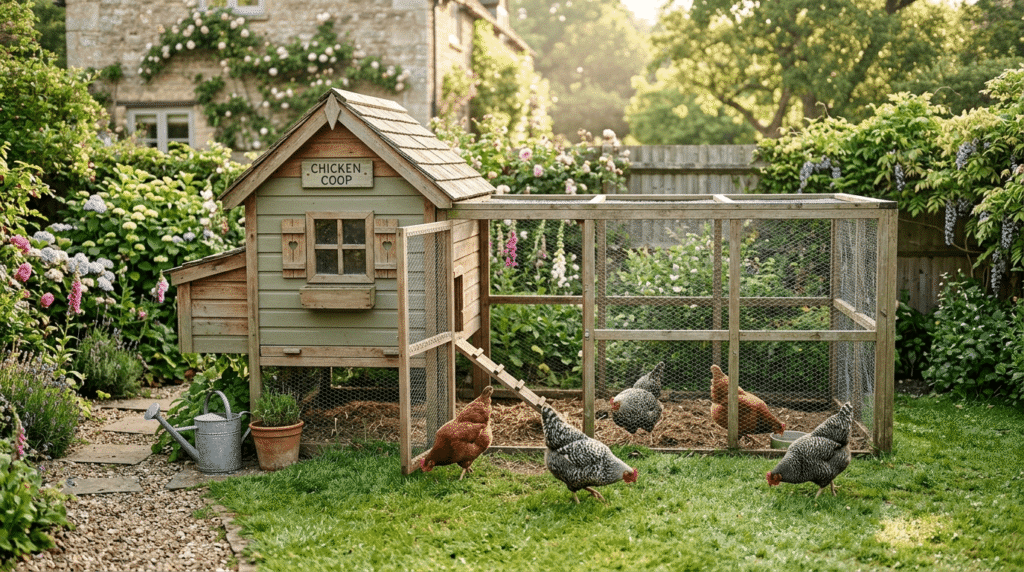
If you’re planning a backyard flock, one question comes before everything else: how big does the coop actually need to be? Get it right and your hens stay calm, clean, and laying. Get it wrong — and too small is the usual mistake — and you invite pecking, mess, disease, and stress.
Here’s the short answer, then the full breakdown with a chart you can bookmark.
The quick answer
For standard-size laying hens, plan for:
- 4 square feet of coop (indoor) floor space per bird
- 8–10 square feet of run (outdoor) space per bird
- 8–12 inches of roost bar per bird
- 1 nesting box for every 3–4 hens
These are sensible minimums. If there’s one rule every experienced keeper repeats, it’s that more space is almost always better — crowding causes far more problems than generous space ever will.
Coop floor space: 4 square feet per bird
The coop is the enclosed, predator-proof house where your chickens sleep and lay. The widely accepted standard for a standard-size hen is about 4 square feet of floor space each, with a sensible range depending on breed:
- Bantams (miniature breeds): ~2 square feet per bird
- Medium breeds (Leghorn, Plymouth Rock, ISA Brown): ~3 square feet per bird
- Standard/large breeds (Orpington, Australorp, Wyandotte): ~4 square feet per bird
- Heavy breeds (Brahma, Jersey Giant): up to ~8 square feet per bird
So a coop of around 16 square feet (a 4×4 footprint) comfortably suits four standard hens.
One important adjustment: the 4-square-feet figure assumes your birds get daily access to an outdoor run. If your chickens will be confined to the coop most of the time, increase indoor space by about 50% — roughly 6 square feet per standard bird — because they’ll be doing all their living, not just sleeping, inside.
Run space: 8–10 square feet per bird
The run is the fenced outdoor area where chickens scratch, dust-bathe, forage, and burn off energy. This is where space matters most for behavior — bored, crowded birds are the ones that start bullying and feather-picking.
- Standard hens: at least 8–10 square feet each
- Large/heavy breeds: closer to 15 square feet each
For four standard hens, that’s a minimum run of about 40 square feet. If your birds free-range in the yard for part of the day, you have more flexibility — but the secure run should still be roomy enough for the whole flock to spend a full day in comfortably, since bad weather and predators will keep them in sometimes.
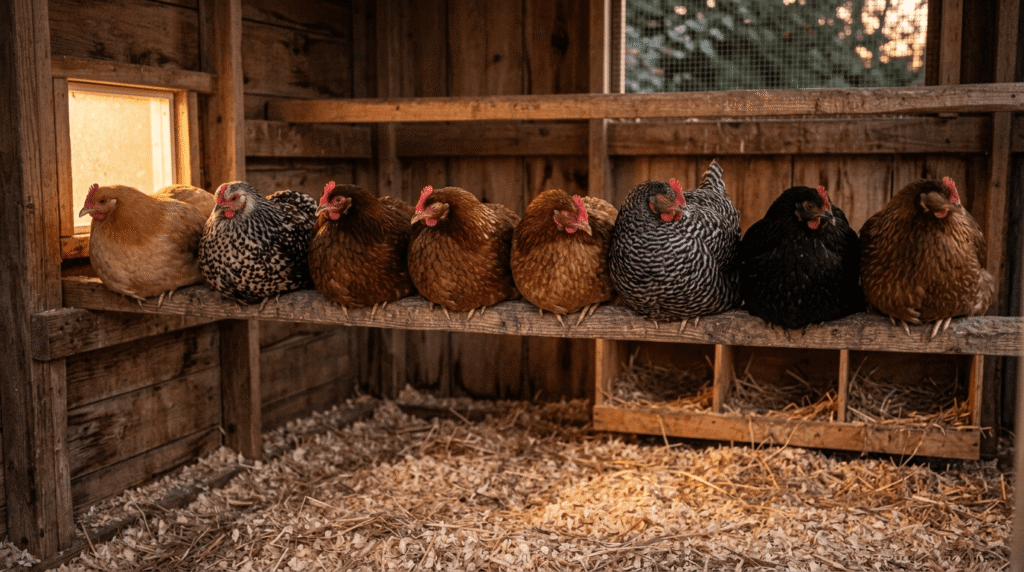
Roost space: 8–12 inches per bird
Chickens instinctively roost off the ground at night for safety. They all need to fit on the roosting bars at the same time, so roost length is often the real limit on how many birds your coop holds.
- Smaller breeds: ~8 inches of bar per bird
- Large breeds: 10–12 inches of bar per bird
A 5-foot roosting bar (60 inches) seats roughly 5–6 standard hens. Two key placement rules: set roosts higher than the nesting boxes (chickens want to sleep on the highest spot, and if the boxes are highest they’ll sleep — and poop — in them), and give a few inches of clearance from walls so tails and wings aren’t crushed.
Note: heavy meat breeds and very large birds shouldn’t have high roosts — jumping down can injure their legs and joints over time. For those, keep roosts low or use a gently angled ladder-style roost.
Nesting boxes: 1 per 3–4 hens
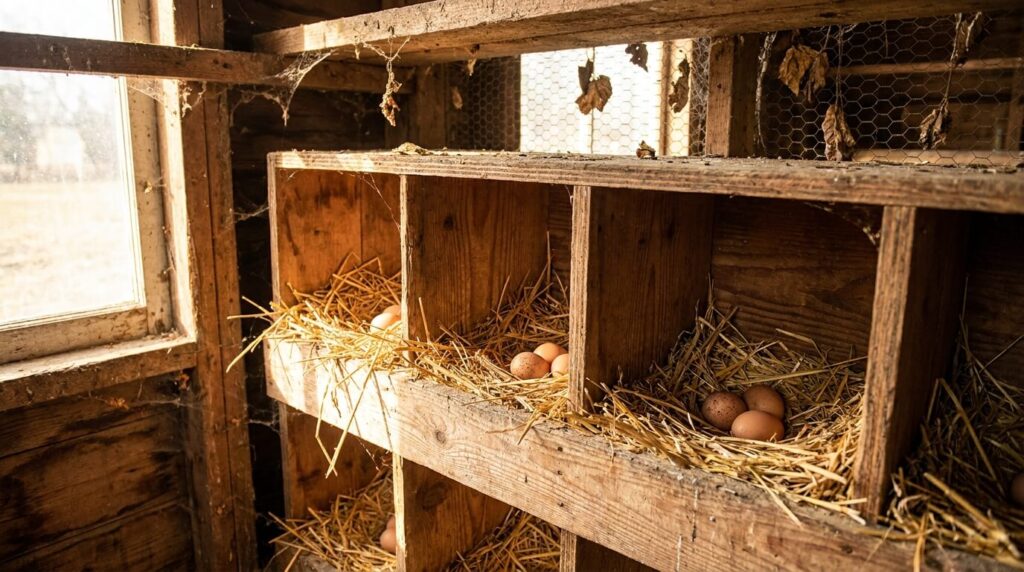
Hens happily share nesting boxes, so you need fewer than you’d think — one box per 3–4 hens, sized around 12×12×12 inches. A flock of six does fine with two boxes.
Place boxes in a dimly lit, lower-traffic spot, visible from the coop entrance but away from the roost. Keep them off the floor and below the roost line. Too few boxes (or boxes in the wrong place) leads to eggs laid on the floor, broken eggs, and egg-eating — a habit that’s hard to break once it starts.
Quick-reference chart
Minimums for standard-size laying hens with access to a run:
| Flock size | Coop floor space | Run space | Roost length | Nesting boxes |
|---|---|---|---|---|
| 3 hens | 12 sq ft | 24–30 sq ft | ~30 in | 1 |
| 4 hens | 16 sq ft | 32–40 sq ft | ~40 in | 1–2 |
| 6 hens | 24 sq ft | 48–60 sq ft | ~60 in | 2 |
| 8 hens | 32 sq ft | 64–80 sq ft | ~80 in | 2–3 |
| 10 hens | 40 sq ft | 80–100 sq ft | ~100 in | 3 |
The prefab-coop trap (read this before you buy)
Here’s the single most useful thing to know if you’re buying a ready-made coop: manufacturer capacity claims are almost always optimistic. A coop advertised as “holds 6 chickens” will realistically house 3–4 standard hens once you do the real math on floor space, roost length, and run size.
Before you buy, ignore the headline number and check the actual dimensions against the chart above. Measure the roost length and the secure run, not just the sleeping box. It’s the most common — and most expensive — beginner mistake, because an undersized coop means buying twice.
Signs your coop is too small
Watch for these once your flock is settled in:
- Feather-pulling, pecking, or visible bullying
- Hens sleeping or crowding in the nesting boxes
- Eggs cracked or eaten in the boxes
- Strong ammonia smell and droppings building up fast
- Birds reluctant to go inside, or fighting at the pop door
Any of these usually points to crowding — either too little floor space, too little roost, or too small a run.
Frequently asked questions
How many chickens fit in a 4×8 coop?
A 4×8 coop is 32 square feet, so about 8 standard hens at 4 sq ft each — provided you also have enough roost length (~80 inches) and a run of 64–80+ square feet.
Can a chicken coop be too big?
Not for space or health — bigger is fine. The only real consideration is winter warmth in very cold climates, where a huge, sparsely filled coop is harder for body heat to keep cozy. For most backyard flocks, err larger.
How much space do chickens need without a run?
If they’re confined indoors most of the time, increase coop floor space by about 50% — roughly 6 square feet per standard bird instead of 4.
Does coop size affect egg laying?
Indirectly, yes. Overcrowding causes stress, and stressed hens lay less and are more prone to disease and feather loss. Adequate space supports steady laying.

Leave a Reply