
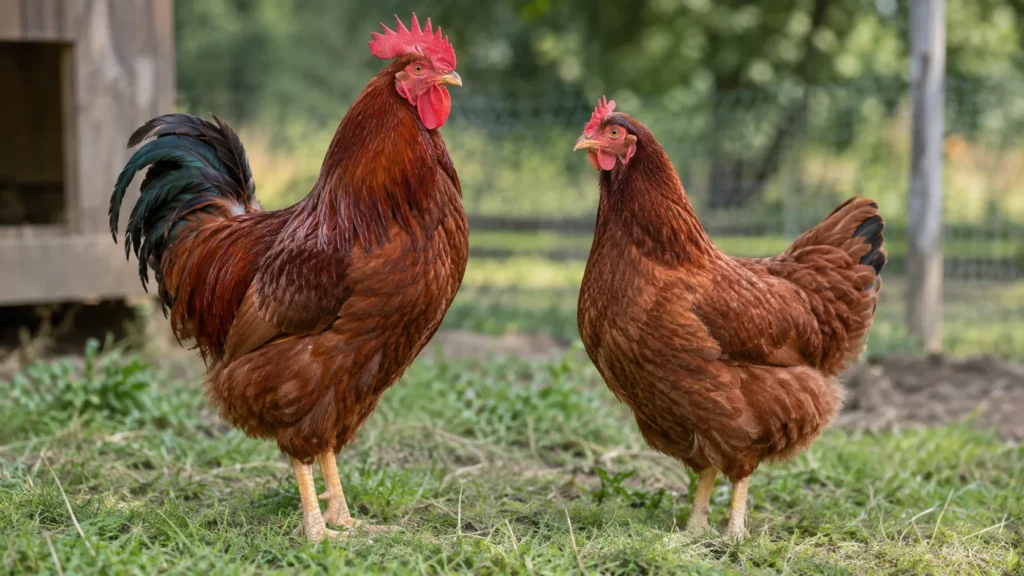
An RIR rooster or hen can usually be identified by comparing comb and wattle development, leg thickness, posture, feathering, behavior, and, later, saddle and hackle feathers. Rhode Island Red roosters often show larger, redder combs earlier, thicker legs, a more upright stance, and pointed neck and saddle feathers, while hens tend to feather more evenly and develop more modest combs.
This guide is for backyard keepers trying to sex Rhode Island Red chicks, pullets, and young cockerels without relying on one unreliable clue. You will learn what to check at each age, which signs matter most, and when to wait before making a final call.
Why Does Telling an RIR Rooster or Hen Apart Take Time?
Rhode Island Reds are a dual-purpose heritage breed, and they do not always declare themselves as early as lighter, more exaggerated breeds. Some pullets grow bold combs, and some slower-maturing cockerels can look hen-like for several weeks.
The most reliable approach is pattern recognition, not a single test. Comb size, color, legs, posture, feather shape, voice, and behavior all become more useful when they line up in the same direction.
A non-obvious expert tip: compare birds from the same hatch, not to photos online. A 7-week Rhode Island Red from one line may mature faster than a 9-week bird from another, so side-by-side comparison within your own group is often the cleanest clue.
RIR Rooster or Hen Checklist: The Most Reliable Signs by Age
The best way to decide whether you have an RIR rooster or hen is to use an age-based checklist. Early signs can suggest a likely answer, but the strongest evidence appears as the bird approaches 10 to 16 weeks.
Use the table below as a practical scoring guide. If several rooster signs appear together, you probably have a cockerel; if the bird stays smaller-combed, round-feathered, and quieter, it is more likely a pullet.
| Sign to check | Typical rooster vs. hen clue | Why it matters |
|---|---|---|
| Comb size and color | Roosters often develop a taller, redder comb earlier; hens stay smaller and paler longer | The comb is hormone-sensitive, so early redness can point toward a cockerel |
| Wattles | Roosters usually show larger, dangling wattles sooner | Wattles often develop alongside the comb and reinforce the same pattern |
| Leg thickness | Cockerels often have sturdier, thicker legs and larger feet | Male birds usually build a heavier frame, even before adult feathers show |
| Posture | Roosters often stand taller and more upright; hens look lower and more horizontal | Body carriage becomes more obvious as young birds gain confidence |
| Feather shape | Roosters develop pointed hackle and saddle feathers; hens keep rounded feather ends | Pointed sex feathers are one of the most dependable later signs |
| Tail development | Roosters may grow higher, more arched tails; hens usually have shorter, neater tails | Tail carriage can support your guess, though it varies by bird |
| Voice | Cockerels may begin awkward crowing; hens make pullet clucks and later egg songs | Crowing is not perfect timing-wise, but it is strong evidence when it appears |
| Behavior | Roosters may chest-bump, guard, tidbit, or challenge more often | Behavior helps confirm physical signs but should not be used alone |
How to Tell an RIR Rooster or Hen Step by Step
Start with age: First, estimate the bird’s age as accurately as possible. A 4-week guess is much less reliable than a 10-week guess, so do not rush the final label. Keep notes or photos weekly so you can see development instead of relying on memory.
Compare combs within the same group: Look at the comb height, thickness, and redness under natural light. If one Rhode Island Red has a bright red comb while its hatchmates are still pale and low, that bird is more likely a cockerel. If all birds are reddening around point of lay, the clue becomes less useful.
Check wattles next: Wattles that enlarge early, especially before 8 to 10 weeks, often support a rooster guess. Pullets can have visible wattles too, but they usually remain smaller until they get closer to laying age. Treat wattles as supporting evidence, not proof.
Look at the legs and feet: Pick the bird up gently and compare leg thickness to hatchmates. Cockerels often feel heavier through the shank and foot, with a broader stance. Do not depend on spur bumps alone because both sexes can have small bumps when young.
Study feather shape: Around 10 to 14 weeks, check the neck and lower back for long, narrow, pointed feathers. In Rhode Island Red cockerels, saddle feathers often begin to drape in front of the tail, while pullets keep a smoother, rounded outline. The American Poultry Association describes Rhode Island Reds as a recognized breed with standard type and color, but sexing young birds still depends on maturity and physical development rather than color alone.
Watch behavior quietly: Spend 10 minutes observing without handling the flock. Cockerels may step between other birds, chest-bump more often, or make alert calls. Hens can be bossy too, especially in a small flock, so only count behavior when it matches the physical signs.
Listen for voice changes: Early crowing can sound like a squeaky hinge rather than a full rooster crow. Some cockerels crow early, while others wait much longer. If the bird crows repeatedly, assume rooster unless you have a rare crowing hen, which is unusual.
Wait for the final confirmation: If you are still unsure at 8 weeks, wait two to four more weeks before rehoming or renaming. By 12 to 16 weeks, most Rhode Island Reds show clearer sex differences. By the time pullets approach laying age, the difference is usually obvious.
At what age can you tell if a Rhode Island Red is a rooster?
You can often make a good guess by 6 to 8 weeks, especially if one chick has a much larger red comb and wattles than the others. A more confident answer usually comes between 10 and 16 weeks, when pointed hackle and saddle feathers, posture, and voice become clearer.
Some Rhode Island Red lines mature quickly, while others keep you guessing. If the bird is from a hatchery sexed pullet order, mistakes can still happen, so watch development instead of relying only on the label.
| Option | Best for | What to expect |
|---|---|---|
| 4 to 6 weeks | Early clues | Comb and leg differences may appear, but mistakes are common |
| 7 to 10 weeks | Reasonable guess | Roosters often show stronger comb, wattle, posture, and behavior signs |
| 11 to 16 weeks | Best visual confirmation | Pointed feathers, crowing, and body shape become more dependable |
| 18 weeks and older | Final confirmation | Hens near laying age, while roosters usually show clear male feathering and behavior |
How to Adapt Your RIR Rooster or Hen Method
For a mixed-age flock: Do not compare a younger Rhode Island Red to older birds. A younger cockerel may look smaller than an older pullet simply because he has had less time to grow. Compare only birds hatched within a few days of each other whenever possible.
For hatchery Rhode Island Reds: Expect some variation in body type, maturity rate, and color depth. Hatchery lines are often selected for production and availability, so they may not match exhibition photos. Use multiple signs rather than assuming every rooster will look dramatic early.
For heritage or breeder lines: Birds may mature more slowly but develop stronger adult type later. A breeder-line cockerel might take longer to show full saddle feathers, yet still end up larger and more masculine. Ask the breeder when males in that line usually become obvious.
For single chicks: Sexing is harder when you have no hatchmates for comparison. Take weekly photos from the side, front, and top so you can track changes in comb, posture, tail, and feather shape. In a single bird, waiting until 12 to 16 weeks is often the fairest method.
For children’s pet flocks: Avoid promising that a chick is a hen too early. Explain that Rhode Island Reds need time to grow before you know for sure. This prevents disappointment if a beloved bird turns out to be a rooster in a neighborhood where roosters are not allowed.
Companion Advice for Raising Rhode Island Reds
If your main concern is whether you can keep a rooster, it helps to understand what roosters actually do in a backyard flock. Cedar & Cluck’s guide to whether hens need a rooster to lay eggs explains the difference between egg production and fertilized eggs, which is important before deciding whether to keep an RIR cockerel.
If you are comparing Rhode Island Reds with other beginner-friendly breeds, temperament and egg production matter as much as sexing. The Cedar & Cluck guide to the best chickens for beginners can help you decide whether Rhode Island Reds fit your flock goals, space, and handling preferences.
Common RIR Rooster or Hen Problems and How to Fix Them
| Problem | Likely cause | Easy fix |
|---|---|---|
| A pullet has a red comb early | Fast maturity or strong production genetics | Wait for feather shape and behavior before deciding |
| A cockerel looks small | Slow-maturing line or lower place in the pecking order | Compare weekly growth and check for pointed saddle feathers later |
| The bird is aggressive, so you assume rooster | Dominant pullet behavior can look pushy | Use body signs, not personality alone |
| No crowing yet | Some males crow late or are suppressed by older roosters | Look for comb, feather, and posture clues instead |
| Tail feathers are confusing | Tail shape varies and can be affected by molt or damage | Focus more on saddle and hackle feather shape |
| Hatchery sexing was wrong | Vent sexing young chicks is not 100 percent accurate | Confirm with development between 10 and 16 weeks |
| Online photos do not match your bird | Different strains, lighting, and ages distort comparisons | Compare to hatchmates and take consistent weekly photos |
When in doubt, slow down and collect more evidence. Most sexing mistakes happen when keepers act on one early sign instead of waiting for several signs to agree.
Long-Term Care Once You Know What You Have
Once you know whether your RIR is a rooster or hen, adjust your plans around space, safety, and flock balance. Rhode Island Red hens are valued for dependable brown eggs, while roosters can be protective but may become too intense in small backyard setups.
Check your local rules before keeping a rooster because many cities and subdivisions allow hens but restrict crowing males. The USDA Animal and Plant Health Inspection Service also emphasizes biosecurity for poultry owners, which matters whether you keep hens, roosters, or both.
For longevity, keep records of each bird’s hatch date, sexing clues, health events, and laying start date. Good records make future Rhode Island Red chicks easier to evaluate because you learn how your particular line develops over time.
Frequently Asked Questions
Are Rhode Island Red roosters darker than hens?
Not reliably. Some Rhode Island Red roosters look deeper and glossier, especially as adult feathers come in, but color alone is not a dependable sexing method. Feather shape, comb development, posture, and behavior are more useful.
Can a Rhode Island Red hen have a big comb?
Yes, Rhode Island Red hens can have noticeable single combs, especially as they approach laying age. A large comb on a mature pullet is normal. The clue matters most when one young bird develops a large red comb much earlier than its hatchmates.
When do Rhode Island Red roosters start crowing?
Some start around 8 to 12 weeks, while others wait until 16 weeks or later. The first attempts may sound rough, cracked, or incomplete. Lack of crowing does not prove the bird is a hen.
Do Rhode Island Red hens get saddle feathers?
Hens have feathers in the saddle area, but they are typically rounded and blend smoothly into the body. Rooster saddle feathers are longer, narrower, and pointed, often draping toward the tail. This sign becomes much clearer after about 10 to 14 weeks.
Are RIR roosters aggressive?
Some Rhode Island Red roosters can be assertive, especially during adolescence, but temperament varies by line and handling. Give them space, avoid teasing or chasing, and do not reward threatening behavior. If a rooster repeatedly attacks people, especially children, he may not be a good fit for a backyard flock.
Can I keep two Rhode Island Red roosters together?
Sometimes, but it depends on space, temperament, number of hens, and whether they were raised together. Two cockerels in a small flock often fight as hormones rise. Have a backup plan before keeping multiple males.
Your Rhode Island Red Will Tell You With Time
The safest way to tell an RIR rooster or hen is to combine age, comb and wattle development, leg size, feather shape, posture, voice, and behavior. One clue can mislead you, but a pattern of clues usually tells the truth.
Give your bird a few extra weeks before making permanent decisions, especially if it is young or the signs are mixed. For more practical chicken-keeping help, visit Cedar & Cluck and keep building a flock you can manage with confidence.
