

Planning your coop and wondering how many chicken nesting boxes you actually need? Good news: you need far fewer than most beginners expect. Hens happily share, so a small flock needs only a couple of boxes. Here’s the simple ratio, a quick chart for your flock size, and the placement details that actually matter.
The quick answer
The standard rule is one nesting box for every 3–4 hens. So:
- Up to 4 hens → 2 boxes
- 5–8 hens → 2–3 boxes
- 9–12 hens → 3–4 boxes
One important caveat: even if you only have two or three hens, build at least two boxes. Hens are creatures of habit and often all want the same favorite box — a second one gives them a backup and prevents traffic jams (and broken eggs) when two want to lay at once.
Why hens need fewer boxes than you’d think
It feels logical to give every hen her own box, but that’s not how chickens work. Hens instinctively want to lay where other hens have laid — it signals a safe spot — so they’ll line up for the same box even when empty ones sit right next to it. Adding a box per bird just wastes coop space and gives them extra spots to sleep in and soil.
That’s why the 3–4 hens per box ratio works so reliably: it gives the flock enough options to avoid real crowding, without building boxes that mostly go unused. This lines up with general flock guidance from resources like Penn State Extension.
How many chicken nesting boxes by flock size
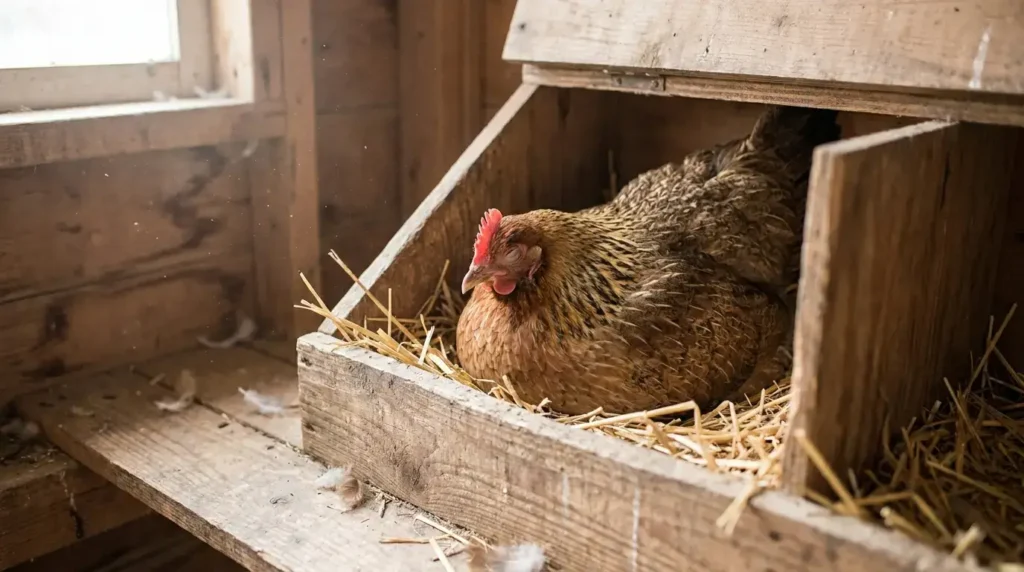
A quick reference, using the 1-per-3-to-4-hens rule with a 2-box minimum:
| Flock size | Nesting boxes |
|---|---|
| 2–4 hens | 2 |
| 5–6 hens | 2 |
| 7–8 hens | 2–3 |
| 9–12 hens | 3–4 |
| 13–16 hens | 4–5 |
| 17–20 hens | 5–6 |
When in doubt, round up — an extra box is cheap insurance against floor-laying.
What size should chicken nesting boxes be?
A box that’s too small gets cramped and dirty; too large and two hens pile in and break eggs. For standard laying breeds, aim for roughly 12 × 12 × 12 inches. Adjust for your birds:
- Bantams (small breeds): about 10 × 10 inches
- Standard hens (Rhode Island Red, Plymouth Rock, ISA Brown): 12 × 12 inches
- Large breeds (Orpington, Brahma, Jersey Giant): up to 14 × 14 inches
Line each box with soft bedding — straw, pine shavings, or a washable nest pad — and top it up regularly to keep eggs clean and unbroken.
Where to place chicken nesting boxes (this matters as much as the count)
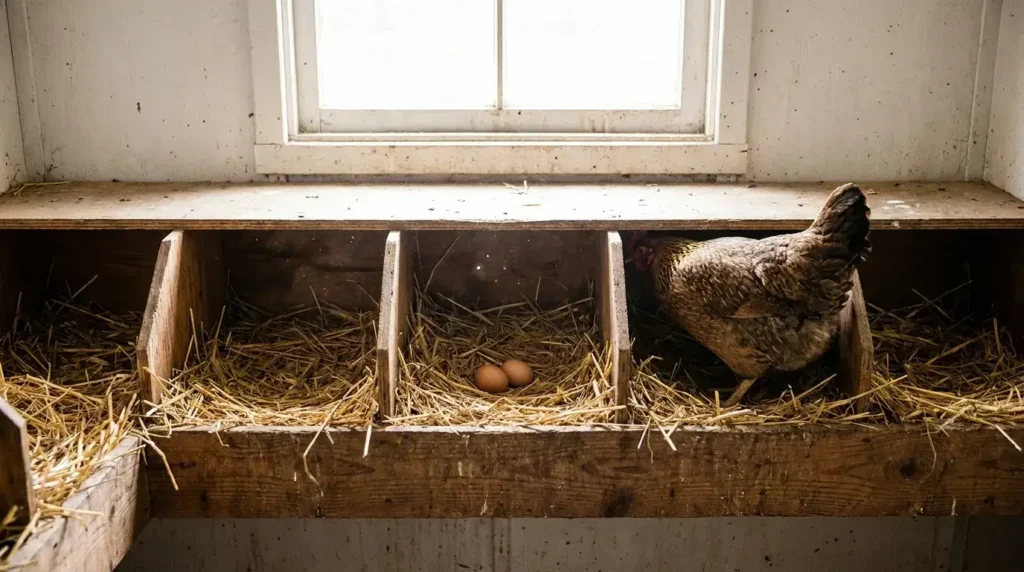
Getting the location of your chicken nesting boxes right prevents most laying problems. See more coop tips in our backyard coop guides:
- Lower than the roosts. Chickens want to sleep on the highest spot. If the boxes are higher than the roosting bars, hens will sleep — and poop — in them, fouling the bedding and eggs. Always set roosts above box level.
- In a dim, quiet corner. Hens prefer a private, shaded spot to lay. Tuck boxes away from the busiest part of the coop and the pop door.
- Off the floor, but easy to reach. Raised a foot or two off the ground keeps bedding cleaner and deters floor-laying, while staying easy for hens to hop into.
Common nesting box problems (and what they mean)
- Eggs on the floor: usually too few boxes, boxes placed badly, or boxes that feel too exposed. Add a box or move them somewhere more private.
- Hens sleeping in the boxes: the roosts aren’t high enough above the boxes. Raise the roosts.
- Broken or eaten eggs: often crowding (too few boxes) or not enough bedding. Add boxes, add bedding, and collect eggs more often.
- One box hogged, others ignored: completely normal — hens favor a “popular” box. As long as you have the right number, let them sort it out.
