
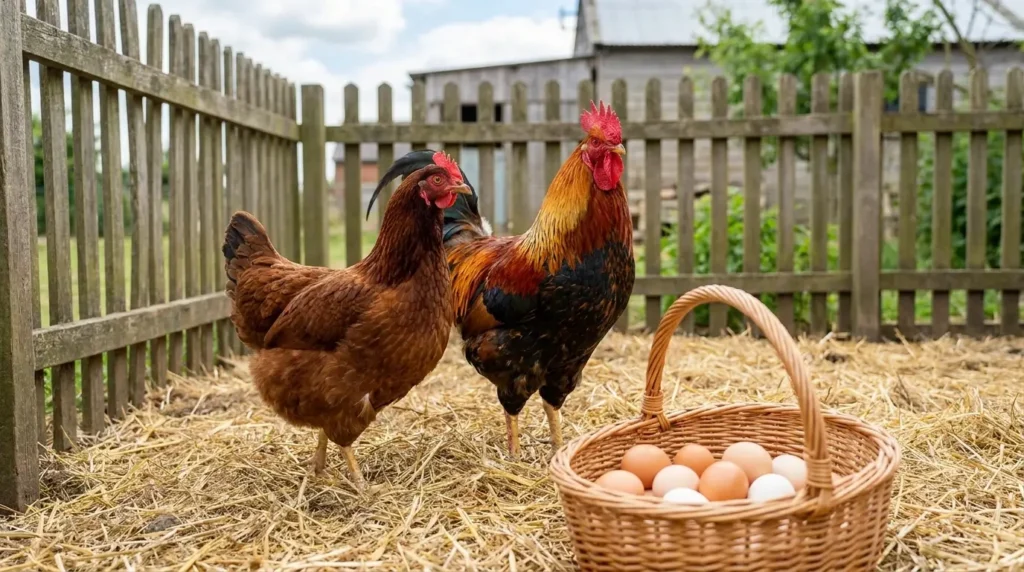
How Do Chicken Eggs Get Fertilized?
Chicken eggs get fertilized when a hen mates with a rooster. During mating, the rooster transfers sperm to the hen. The sperm then travels inside the hen’s reproductive tract and can fertilize the yolk shortly after the hen releases it from her ovary.
The important thing to understand is this: a hen can lay eggs without a rooster, but those eggs will not be fertilized. A rooster is only needed if you want the egg to have the possibility of developing into a chick.
Fertilization happens inside the hen’s body before the shell forms. By the time the egg is laid, the egg has already finished forming.
Do Hens Need a Rooster to Lay Eggs?
No, hens do not need a rooster to lay eggs.
A hen naturally produces eggs as part of her reproductive cycle. This is why backyard hens and commercial laying hens can lay eggs even when no rooster is present.
However, without a rooster, the eggs are unfertilized. That means they can be eaten, but they cannot hatch into chicks.
A simple way to remember it:
Hen only = eggs for eating
Hen + rooster = eggs that may be fertile
Where Does Fertilization Happen Inside the Hen?
Fertilization happens in the infundibulum, which is the first part of the hen’s oviduct.
Here is the basic process:
- The hen releases a yolk from her ovary.
- The yolk enters the oviduct.
- If sperm from a rooster is present, fertilization can happen near the beginning of the oviduct.
- The rest of the egg forms around the yolk.
- The egg white, membranes, shell, and bloom are added before the egg is laid.
This means the shell does not form first. The yolk comes first, and the rest of the egg is built around it.
Step-by-Step: How Chicken Eggs Get Fertilized
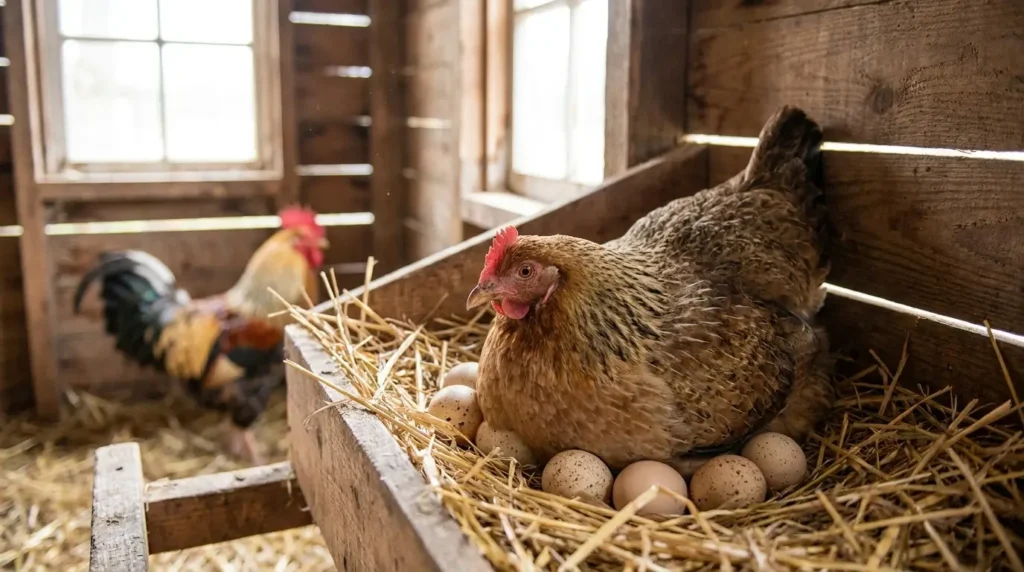
1. The rooster mates with the hen
For an egg to be fertilized, a rooster must mate with the hen. Chickens do not reproduce the same way mammals do. Instead, sperm is transferred through brief cloacal contact.
This allows sperm from the rooster to enter the hen’s reproductive tract.
2. The hen stores sperm
After mating, the hen can store sperm inside her reproductive tract for several days or even longer. This is why one mating can result in multiple fertile eggs over time.
The rooster does not need to mate with the hen before every single egg.
3. The hen releases a yolk
The yolk is the true egg cell. When the yolk matures, the hen releases it from her ovary. This process is called ovulation.
Once released, the yolk moves into the oviduct.
4. Fertilization happens before the shell forms
If sperm is available when the yolk enters the upper part of the oviduct, the egg can become fertilized.
This happens before the egg white and shell are added.
5. The egg finishes forming
After fertilization, the egg continues moving through the hen’s oviduct. During this journey, the hen’s body adds:
- Egg white
- Shell membranes
- The hard outer shell
- A protective coating called the bloom
This full process takes about one day.
6. The hen lays the egg
When the egg is complete, the hen lays it. If it was fertilized and placed under the right incubation conditions, it may develop into a chick.
If it is not incubated, development stops.
Fertilized Egg vs Unfertilized Egg
A fertilized egg and an unfertilized egg can look almost the same from the outside. You cannot tell if an egg is fertile just by looking at the shell.
The main difference is inside:
| Type of Egg | Rooster Needed? | Can It Hatch? | Safe to Eat? |
|---|---|---|---|
| Unfertilized egg | No | No | Yes |
| Fertilized egg | Yes | Yes, with proper incubation | Yes |
| Store-bought egg | Usually no | Usually no | Yes |
| Hatching egg | Yes | Yes, if fresh and incubated correctly | Usually bought for hatching, not eating |
A fertilized egg does not automatically become a chick. It needs the right warmth, humidity, and turning for development to continue.
Can Store-Bought Eggs Be Fertilized?
Most store-bought eggs are not fertilized because commercial laying hens are usually kept without roosters.
Even if an egg came from a flock with roosters, it still needs proper handling and incubation to hatch. Refrigerated eggs are usually not suitable for hatching because cold storage stops development and lowers hatchability.
So, for most people, grocery store eggs are simply eggs for eating, not eggs for hatching.
How Long After Mating Are Chicken Eggs Fertile?
A hen may start laying fertile eggs within a couple of days after mating with a rooster.
This happens because the egg already inside the hen may be too far along in formation to be fertilized. The next yolk released after mating has a better chance of becoming fertile.
After successful mating, a hen can continue laying fertile eggs for a period of time because she can store sperm internally.
How Long Does It Take a Fertilized Egg to Hatch?
A fertilized chicken egg usually takes about 21 days to hatch under proper incubation.
For a chick to develop, the egg must be kept at the right temperature and humidity. It also needs to be turned regularly during most of the incubation period.
Without incubation, a fertilized egg will not continue developing into a chick.
Can You Eat Fertilized Chicken Eggs?
Yes, fertilized chicken eggs are safe to eat when they are fresh and properly handled.
Many people worry that a fertilized egg will contain a baby chick, but that is not how it works. A fertilized egg only begins developing when it is kept under the right incubation conditions.
If the egg is collected daily and stored for food, it remains just an egg.
How Can You Tell If an Egg Is Fertilized?
There are two common ways to check if an egg is fertilized:
1. Crack the egg and check the yolk
If you crack an egg open, you may see a small white spot on the yolk. This spot is called the germinal disc.
In an unfertilized egg, the spot usually looks like a small white dot. In a fertilized egg, it may look more like a small bullseye or ring.
This method is useful for learning, but the egg cannot be hatched after you crack it.
2. Candle the egg during incubation
Candling means shining a bright light through the egg to look for signs of development.
After several days of incubation, a fertile developing egg may show veins or a dark growing area inside. An infertile egg will usually stay clear.
Candling is the better method if you want to hatch chicks because it does not require opening the egg.
Do All Eggs From a Hen With a Rooster Become Fertilized?
No, not every egg from a hen with a rooster is guaranteed to be fertilized.
Fertility depends on several factors, including:
- Rooster health
- Hen health
- Age of the birds
- Mating success
- Rooster-to-hen ratio
- Season and daylight
- Nutrition
- Stress levels in the flock
A rooster increases the chance of fertile eggs, but fertility is never 100% guaranteed.
How Many Hens Can One Rooster Fertilize?
For many backyard flocks, one healthy rooster can usually manage several hens. A common backyard ratio is around one rooster for 8 to 12 hens, depending on breed, rooster behavior, and flock conditions.
Too many roosters can stress hens. Too few roosters in a large flock may reduce fertility.
For a small backyard flock, one rooster is usually enough if your goal is fertile eggs.
Why Are Some Eggs Not Fertile Even With a Rooster?
Eggs may not be fertile even when a rooster is present. Common reasons include:
The rooster is too young or too old
A young rooster may not be fully mature yet. An older rooster may have reduced fertility.
The hen avoids the rooster
Some hens do not accept certain roosters. If mating does not happen successfully, the eggs will not be fertile.
The flock is stressed
Stress can affect both egg production and fertility. Loud environments, poor housing, predators, overcrowding, and sudden changes can all affect the flock.
Nutrition is poor
Healthy reproduction requires good nutrition. Breeding chickens need a balanced diet with enough protein, vitamins, minerals, and calcium.
The rooster has too many hens
If one rooster has too many hens, he may not mate with all of them often enough.
Do Fertilized Eggs Taste Different?
No, fertilized eggs do not normally taste different from unfertilized eggs.
When eggs are collected fresh and stored properly, most people cannot tell the difference by taste, smell, or appearance.
The difference only matters if you are trying to hatch chicks.
What Happens If You Incubate an Unfertilized Egg?
Nothing will develop.
An unfertilized egg cannot grow into a chick because it does not contain the genetic material from a rooster. It may look normal from the outside, but it will not hatch.
This is why candling is useful during incubation. It helps you remove eggs that are not developing.
Best Conditions for Hatching Fertilized Eggs
If you want fertilized eggs to hatch, they need proper incubation.
Important hatching conditions include:
- Fresh fertile eggs
- Correct temperature
- Correct humidity
- Clean eggshells
- Regular turning during incubation
- A stable incubator or broody hen
- Minimal disturbance near hatch day
Fertilized eggs are alive only in the sense that they have the potential to develop. Without proper incubation, that development does not continue.
Common Myths About Fertilized Chicken Eggs
Myth 1: Hens need roosters to lay eggs
False. Hens lay eggs without roosters. Roosters are only needed for fertilization.
Myth 2: Every egg from a backyard flock can hatch
False. Only fertilized eggs can hatch, and even fertile eggs need proper incubation.
Myth 3: Fertilized eggs are not safe to eat
False. Fresh fertilized eggs are safe to eat when collected and stored properly.
Myth 4: You can tell if an egg is fertilized by the shell
False. The shell does not show whether the egg is fertile.
Myth 5: A fertilized egg instantly becomes a chick
False. A fertilized egg needs incubation before development continues.
How Chicken Egg Fertilization Works in Simple Words
Chicken egg fertilization happens when a rooster mates with a hen and sperm reaches the yolk before the rest of the egg forms. The hen can lay eggs without a rooster, but those eggs will be unfertilized. If a rooster is present, some eggs may become fertile and can hatch into chicks after about 21 days of proper incubation.
FAQ About How Chicken Eggs Get Fertilized
So, how do chicken eggs get fertilized? The answer is simple: a rooster must mate with a hen, and the sperm must meet the yolk inside the hen before the shell forms. Hens do not need roosters to lay eggs, but they do need roosters to produce fertile eggs that can hatch.
For backyard chicken keepers, this is one of the most useful things to understand. If you only want fresh eggs to eat, hens are enough. If you want chicks, you need fertile eggs, proper incubation, and healthy breeding birds.
